For most people, energy is simply a utility, something we rarely stop to think about. For businesses, it is a vital asset, and as more operations electrify, it is becoming essential.
In recent years, however, that asset has at times looked more like a liability. A decade ago, energy was a bill to be paid: a necessary evil. Since then, major change across the energy sector has made it far more volatile, to the point where it is now a strategic risk, both operationally and at board level.
In fact, the ONS reported that 64% of businesses had some degree of concern about energy prices in early September 2026, up five percentage points on late August.
This concern is well founded. Businesses responding to the ONS survey pointed to conflict in the Middle East as a reason, while wider inflation has pushed up the cost of operations, parts and more. Energy is no longer a passive utility you pay for each month; it is a risk that needs managing.
The knock-on effect of all this is now visible. In its March 2026 survey, the ONS found that 25% of trading businesses cited energy prices as a reason for considering raising their prices, the highest since 2023. Only labour costs (29%) were of greater concern, with raw material prices (22%) and finance costs (16%) close behind. And these are businesses considering a price rise, not the many that have already had to make that call.
Let’s examine what the risks really are and what you can do to address them.
Volatility & Costs Are Real
It is fair to say the past few years have been volatile, from geopolitics to the wider economy.
The wholesale price is only part of that story. Non-commodity costs (network charges such as TNUoS and DUoS, balancing costs, policy levies and supplier risk premiums) now make up around 60–64% of a typical business electricity bill. From April 2026, EDF calculates that the average transmission residual charge rose from ~£15.70/MWh to ~£25.70/MWh equivalent, an increase of roughly 64%. Those costs go up whether your consumption does or not.
Additional costs are only part of the whole picture. Businesses are using more electricity, not less. EV charging, heat pumps, advanced HVAC, automation and IT loads are all increasing site capacity requirements and peak demand exposure.
You can’t control the market. But you can control your demand profile, your visibility, when you use power and where it comes from. That starts with understanding your energy well enough to turn it to your advantage. That requires data. The game has changed, but data still matters. The approach is simple: measure, benchmark, then improve. That is the job of an energy management system (EMS), such as the EnergyForce EMS.
You’ve Got the Data. Now What?
If knowledge is power, then data is the foundation. An EMS shows you where and when energy is used, site by site and circuit by circuit, and benchmarking gives you something to measure against. But a benchmark on its own doesn’t cut a bill.
Timing is where the savings sit, and that comes back to network charges. The DUoS red, amber and green time bands show when the local network charges most. The red band typically runs from around 4pm to 7pm on weekdays, though exact times vary by network region. In addition, Ofgem’s Targeted Charging Review moved the largest part of TNUoS for businesses into a fixed daily charge, set by your site’s connection voltage and capacity band. So today, there are two clear levers: keep peak demand within your agreed capacity, and keep as much consumption as possible out of the red band.
Using an EMS provides data, in real time, that, when used and interpreted properly, can lead to significant improvements in your energy profile. The data shows you the problem, but it doesn’t solve it. Insight only pays off once it changes something: when a machine runs, when a charger draws power, when the site pulls from the grid at all. And that still needs someone who knows how to read it.
Storage Turns Insight Into a Decision You Can Act On
Once you know when your costs peak, you need the means to do something about it. That’s where solar PV and battery storage come in. Generation reduces what you import. Storage closes the gap between when you generate power and when you actually need it. Charge the battery from midday solar or cheaper overnight power, then discharge it when the red band hits. The wider storage market is growing too: in late 2024, Cornwall Insight forecast that annual revenues for grid-scale 2-hour battery assets would rise from around £96/kW in 2025 to around £108/kW in 2026.
Solar adoption continues to grow across homes and businesses, and today’s panels are more efficient than ever. For most commercial sites, solar PV remains the most reliable and scalable route to reducing grid dependency. At Rybrook Blythe Valley Specialist Cars, for example, we installed a 62kWp system of 164 roof-mounted panels in a single week, with estimated annual production of up to 54,660kWh.
The market now rewards that flexibility, too. Since Elexon’s P415 modification went live in November 2024, businesses can work with an independent aggregator (registered as a Virtual Trading Party) to sell their flexibility into the wholesale market without going through their energy supplier. Alongside that, NESO’s Demand Flexibility Service now runs year-round and has lowered its entry threshold to 0.1MW, opening the door for more commercial sites to be paid for shifting demand. A battery is no longer just a store of energy; it can be an active, revenue-generating asset.
Those mechanisms respond to price and demand signals in real time. But it’s your EMS data that tells you when to pull the lever, and when your own site needs the power more than the market does.
That’s why flexibility (using power at the right time rather than any time) is a financial lever, not just good practice. Bring EMS, battery and generation together, and you can choose, hour by hour, whether to import, self-supply or export, rather than taking whatever the grid offers at whatever moment demand happens to hit.
Combining energy generation with battery storage has always been a two-part solution for reducing grid dependency, but now it comes with the benefit of mitigating risks presented by volatile market conditions as well as potentially even creating an active revenue-generating asset.
What Flexibility Actually Looks Like
That may sound good in theory, so let’s make it practical. For car dealerships, with large roofs, sizeable forecourts and a growing number of EVs to prepare, flexibility is a daily operational decision. Here’s how it plays out in two realistic scenarios.
Scenario 1: The flagship showroom
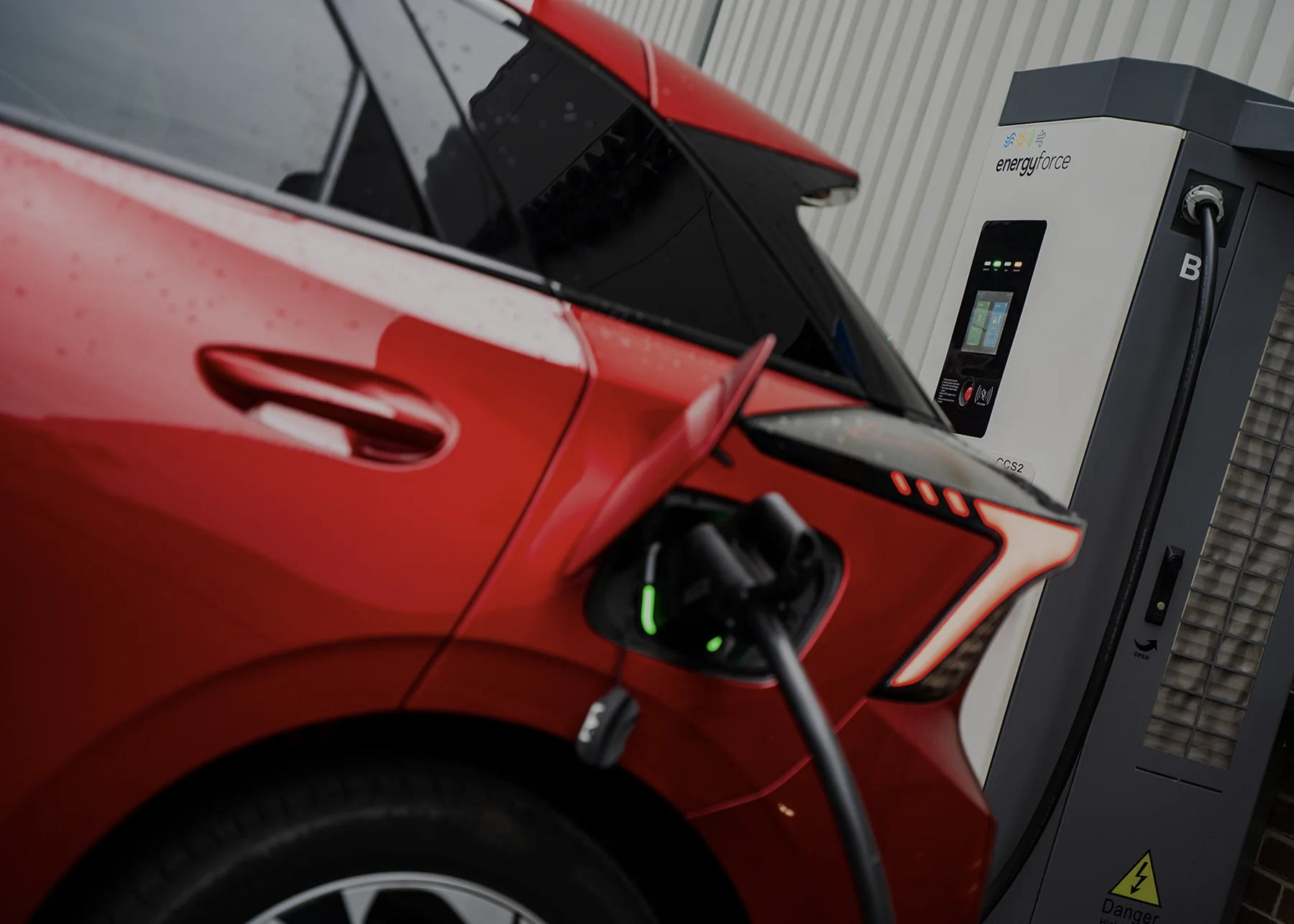
A franchised dealership runs a busy workshop, a large glass-fronted showroom, several AC wallboxes and a DC rapid charger for pre-delivery inspections (PDI) and demonstrators. Like many dealerships, it has a constrained grid connection and chargers in heavy use throughout the day. Most EVs go on charge at around 4:30 pm as the workshop day winds down. That’s right at the start of the red band, and on top of the building’s own evening load.
With flexibility built in:
- Charging is scheduled, not left to chance. Vehicles due for handover tomorrow are still plugged in at 4:30 pm, but ChargeControl holds them until after 7 pm (well after close) or the overnight green band. That makes the most of the available capacity. Only same-day handovers draw power during the peak.
- HVAC works ahead of the peak. The showroom is pre-heated in winter or pre-cooled in summer before 4 pm, then allowed to coast through the red band rather than running flat out.
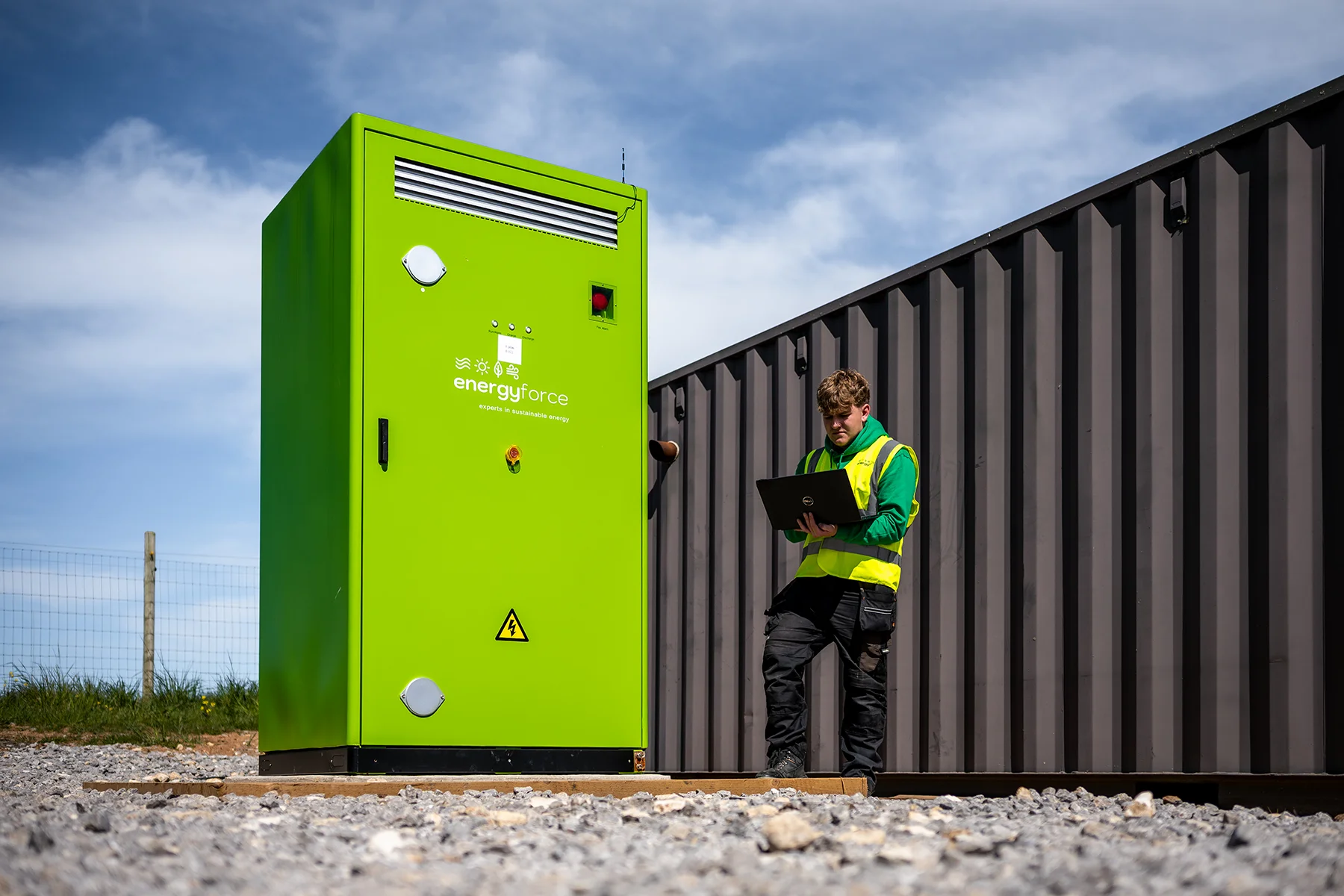
- The battery is saved for when it counts. An on-site control system sets the battery around the dealership’s opening hours. Instead of trickling out power through the day, it charges from rooftop solar and discharges across the 4 pm – 7 pm window. That covers the rapid charger and the evening load, keeping grid draw to a minimum.
- Capacity stays in check. Lower peaks mean the site can add chargers without breaching its agreed capacity and, in many cases, without an expensive grid upgrade. This is the principle behind EnergyForce Capacity+, which stores energy while the site is quiet and releases it at busy times.
Scenario 2: The multi-site dealer group
A group runs 15 dealerships across a region. Every site has a bill, but not every site offers the same opportunity. Using EMS data, the group benchmarks each site’s consumption against showroom floor area, number of workshop ramps, vehicles prepared and charger usage. Four sites stand out:
- The constrained site. It’s already at its capacity limit, and the manufacturer wants more rapid chargers. Battery storage lets it add charging without waiting on grid reinforcement. Where connection work is still needed, our accreditation as an Independent Connection Provider (ICP) means we can deliver it ourselves, alongside the rest of the project rather than waiting on the network operator.
- The high-demand workshop. With a Smart Repair operation and several workshop ramps, this site’s daytime demand is far higher than its neighbours’. Its capacity requirements need planning around that load, not the group average.
- The solar-ready site. A large, south-facing workshop roof and heavy daytime demand make it the strongest case for solar first.
- The overnight outlier. Unusually high consumption after closing points to lighting or HVAC running with nobody there. It’s a quick, low-cost fix before any capital is spent.
That’s how a multi-site audit turns a list of buildings into a ranked delivery plan, so investment goes where it pays back fastest.
None of this is theoretical. In phase 1 of our solar programme with Vertu Motors, we installed more than 6,700 roof-mounted panels across more than 40 of the group’s dealerships. Together they are expected to generate in the region of 2,000 MWh of electricity, at least a quarter of those sites’ total consumption, while offsetting a combined 596 tonnes of CO2. Phase 2 is now nearing completion. Elsewhere, our multi-site project with Rybrook Automotive brought almost 4,000 solar panels and 71 EV charging stations, providing 141 charging sockets, to 17 dealership sites.
Investment, Not Cost
When bills creep up every year, any new spend can feel like just another cost. It isn’t. EMS, generation and storage working together turn energy from a liability you pay for into an asset you manage. They reduce what you buy, shield you from peak charges and, where it makes sense, earn revenue by selling energy back to the grid.
No one has a crystal ball. But with electrification accelerating and network costs rising, it would be optimistic to expect a return to the old normal. Complete grid independence is rarely realistic, and it doesn’t need to be the goal. A realistic version of independence, where your site generates a meaningful share of its own power and decides when to draw on the grid, is achievable. And it gives you far more control over what energy costs your business.
A Strategy You Can Work With
Energy is more expensive, more volatile and more central to operations than it was just a few years ago. The businesses handling it best are treating it as something to manage, not just something to pay for, and that approach is fast becoming a business reality rather than an ambition.
The strategy is a simple loop:
- Measure: an EMS shows you where, when and how energy is used.
- Generate & store: solar and battery storage give you power you control.
- Act: use the data to decide when to charge, heat, cool, store, import or export.
You don’t need to put all three in place at once. The first step is understanding where your sites stand today and which options make sense for them. Since 2014, EnergyForce has delivered hundreds of projects nationwide, handling everything from design and grid connection to installation, 24/7 monitoring and maintenance.